Idle War plays itself, but a lot is going on underneath. This post walks through the rules that decide how a battle goes: how ships and enemies are built, how equipment and pilots add up, how everyone levels during a mission, and what makes one mission different from the next.
1. Ship sizes, tags and who gets shot
Every ship has a size which dictates how many can be used, as each mission also has a formation size limit.
During the main stories of Volume 1, the player is limited to a capacity of 2, which means only the Corsair can be used. The Bulwark is unlocked at the end of mission 5, and it can then be used in the free play mode of Volume I, which has a capacity of 5. Besides this capacity, there's also a ship limit, which currently is set to 5, even though this might change in future updates.
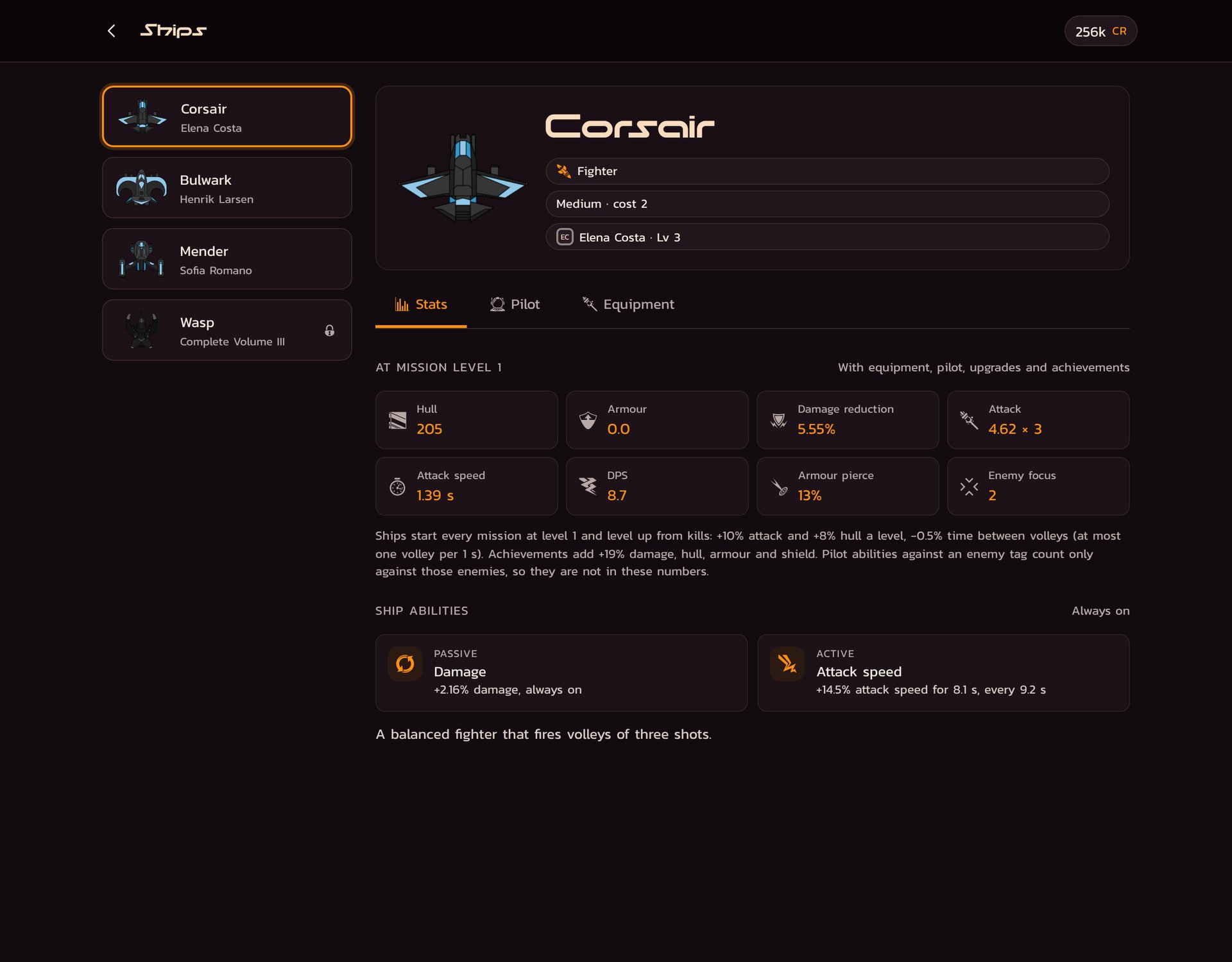
Additionally, each ship as a focus. This determines which ship gets targeted by the enemies, as a probability. For example, with the Corsair's focus of 2 and Bulwark's of 4, if they are the only 2 ships in the formation the Bulwark will on average take two thirds of the attacks (4 / (2 + 4)). There will be enemies that will have different target rules though.
Tags
Enemies have specific tags, which are used by some of the player bonuses. Currently there are 8 different tags, 3 of which are added automatically if the enemy has a specific property:
- small, large, swarm, striker and support are set on the enemy.
- armoured means it has armour of 1 or more. shielded means it has a shield. boss is any boss.
- Anything a carrier launches counts as a swarm.
| Enemy | Tags |
|---|---|
| Drone | small, swarm |
| Interceptor | small |
| Gunship | armoured |
| Bosses | their base enemy's tags, plus boss |
Tags are then used by some pilot abilities. An ability such as "+7.5% damage against swarm" adds to a ship's damage only when the target has that tag. The same works in reverse: "less damage from striker" reduces hits from strikers. The player can see the tags of every enemy in a mission on its briefing screen, so choose pilots wisely.
Hits
Every bonus in the game is a percentage, and percentages add together before they are applied. So +10% from equipment, +2% from a passive and +3.75% against swarm is +15.75% damage, not three separate multipliers.
A hit then goes through three layers:
- Shield takes the damage first. When it breaks, it stays offline for a few seconds before it regenerates.
- Armour is chipped. Each hit removes 30% of its damage from the armour, and only the attacker's armour pierce share goes through to the hull. A hit big enough to strip the armour sends the rest to the hull.
- Hull takes what is left. At zero the ship is destroyed.
Example: a Corsair hit does about 2.8 damage at level 5. Against armour 1, it needs 1 / 0.3 = 3.3 damage to strip it, so the hit only chips the armour, and the 5% pierce sends 0.14 to the hull.
2. Equipment and boxes
Each ship has six pieces of equipment. It doesn't come with any equipment, but it won't be long until the player starts unlocking them. Each one adds a percentage to a stat, and the amount grows with its level and its quality. Using the Corsair's equipment as an example we have:
| Slot | Piece | Effect | Per level |
|---|---|---|---|
| 1 | Twin Repeaters | Damage | +1% |
| 2 | Targeting Array | Damage | +1% |
| 3 | Light Frame | Hull | +1% |
| 4 | Composite Skin | Damage reduction | +0.05% (max 50%) |
| 5 | Flight Computer | Active ability effect | +0.5% |
| 6 | Overdrive Coil | Active ability duration | +0.5% (max 50%) |
Quality and levels
There are four qualities. Quality multiplies the per-level bonus and sets how high the piece can be levelled:
| Quality | Multiplier | Highest level | Twin Repeaters at the top |
|---|---|---|---|
| Common | ×1 | 10 | +10% damage |
| Uncommon | ×2 | 20 | +40% damage |
| Rare | ×4 | 30 | +120% damage |
| Epic | ×8 | 40 | +320% damage |
Common and uncommon are available on version 0.5. Rare and epic arrive in a future update, once I decide how it will get unlocked. It will either be when reaching a specific volume, a specific difficulty (which is another feature being re-introduced soon) or a mix of both.
I also need to decide if there will be equipment pieces with infinite levels but diminuishing returns.
What a find does
- A piece not yet owned arrives at level 1.
- A better quality than the one owned replaces it and keeps the level.
- The same or a lower quality adds levels. A common find on an uncommon piece adds half a level, because common is half as strong. At the same quality it adds one full level.
- A piece that is at its highest level and quality is skipped, so a find is never wasted on one.
Where equipment comes from
Boss drops. The first time the boss is killed it always drops a piece. When repeating the same mission, each boss kill has a 5% chance, which the Boss drops upgrade can raise by 0.5% level (up to 5% for a total of 10%). It will prefer to drop for a ship with less equipment pieces and choose equipment pieces the player doesn't own yet. Only ships on the mission count, not all the ships in the fleet.
- A ship's chance is its weight divided by the total of all the weights (weight is
1 + 1 × kwhere k is the number of missing pieces). - Example: the Corsair is missing 6 pieces (weight 7) and the Bulwark is missing 2 (weight 3). That makes the Corsair 70% and the Bulwark 30%.
Equipment boxes. A box costs 10,000 credits (less with the Box discount upgrade) and holds 5 pieces for the ship selected. With only common and uncommon available, each piece is common 62.5% of the time and uncommon 37.5%. Every 10th box also guarantees one piece of the best quality currently unlocked. The count is kept per ship, and it resets whenever a box gives that best quality item.
- The chance of getting a new piece is
(3 × k) ÷ ((3 × k) + n), where k is the number not owned and n is the number owned that can still improve. - Example: 4 not owned and 2 owned gives 12 / 14, so 86% for a new piece, and each individual new piece is 21.4%.
3. Pilots
Every ship needs a pilot. Pilots do not change the ship's own stats directly. They carry abilities, and each ability is a bonus that applies to their own ship ("self") or to every ship in the fleet ("fleet").
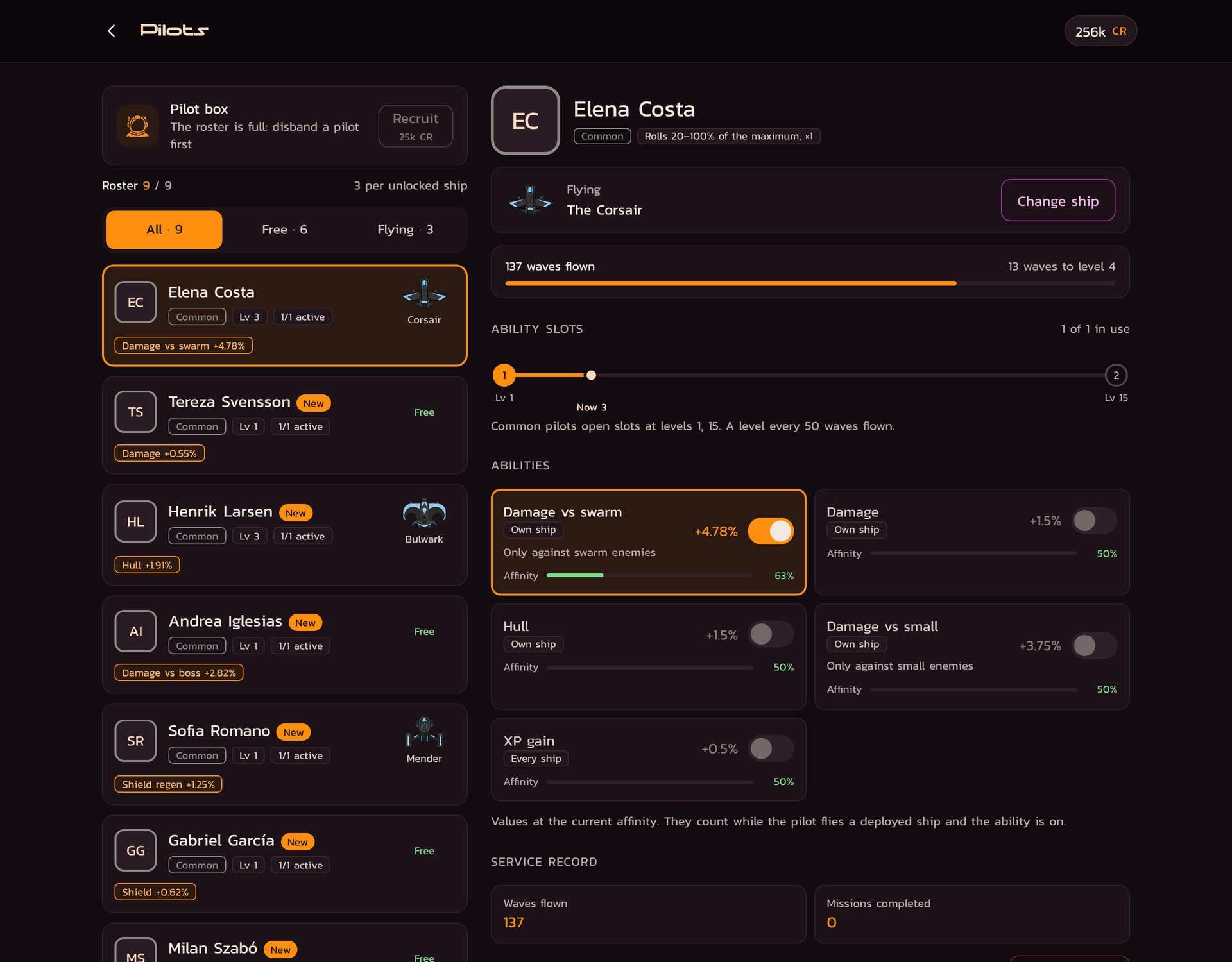
Elena Costa, the starter pilot, has these:
| Ability | Scope | Perfect roll | Right now |
|---|---|---|---|
| Damage against swarm | Own ship | +7.5% | +3.75% |
| Damage | Own ship | +3% | +1.5% |
| Hull | Own ship | +3% | +1.5% |
| Damage against small | Own ship | +7.5% | +3.75% |
| XP | Every ship | +1% | +0.5% |
Only active abilities count, and a common pilot starts with one active slot, filled with the first ability in the list. So at the start only the swarm bonus is working, and the others wait for a second slot or a swap. The “Right now” column is what each would give while active.
Where the numbers come from
- Roll. Each ability has a maximum, and a pilot rolls a share of it. Pilots earned from opening boxes roll randomly between a minimum (based on rarity) and 100%. Common has a base of 20%, uncommon 50%. The fixed story pilots, like Elena, roll 50%.
- Quality. The ability value is also multiplied by the pilot's quality: ×1 for common, ×1.5 for uncommon.
- Affinity. An active ability only gives a share of its value when is first activated. That share starts at 50% and grows by 1% for every 10 waves the ability is active, up to 100%. Full strength takes 500 waves, so a pilot is a long-term investment.
- Slots. A pilot has five abilities, but only some are active. Common and uncommon pilots have one active slot at the start and a second at pilot level 15. The first abilities in the list are active first. They can be switched at any time.
- Pilot level. A pilot gains a level for every 50 waves they complete, up to level 15. The Pilot training upgrade makes each wave count for 3% more per level.
Getting pilots
The first pilot is Elena Costa. Each new ship comes with a common pilot, and finishing Volume I brings Henrik Larsen, a fixed pilot picked for the Bulwark.
A pilot box costs 25,000 credits and grants one pilot, using the same odds as an equipment box: uncommon 37.5% of the time, with every 10th box guaranteed uncommon.
There's also a roster limit of three pilots per unlocked ship. They can also be swapped between ships without penalty, or disbanded if no longer required.
4. Ships level up inside a mission
Ships do not carry levels from one mission to the next. Every mission starts at level 1, and ships level up from the enemies they kill. When the mission ends or is restarted, the levels are gone. The long-term growth comes from equipment, pilots, achievements and upgrades, which all feed into the same percentages.
The stat formula
For each stat, the level adds a fixed share of the base value. The Corsair's growth is damage +10%, hull +8% and attack interval −0.5% per level. In general:
stat at level L = base × (1 + growth ÷ 100 × (L − 1)), and then the sum of every bonus is applied on top.
| Corsair at level | Damage per shot | Hull | Fire interval |
|---|---|---|---|
| 1 | 2.0 | 100 | 1.50 s |
| 5 | 2.8 | 132 | 1.47 s |
| 10 | 3.8 | 172 | 1.43 s |
| 20 | 5.8 | 252 | 1.36 s |
The Corsair fires a volley of three shots, and the damage shown is per shot. The fire interval never drops below a minimum that depends on each ship. The Corsair for example has a minimum of 1 second.
What it costs to level up
Levelling uses XP. The level 1 to 2 step needs 500, then 600, 700, 800 and so on, so each level costs 100 more than the last. Every kill gives XP equal to the enemy's value. The ship that lands the killing blow gets all of it, and the other ships in the fleet get a share (50% for the Corsair and Bulwark). Bonuses to XP gain apply on top. A drone at wave 1 is worth 50 XP, so the Corsair's first level takes about 10 drone kills.
When a ship levels up, the extra hull, armour and shield it gains are added to what it has now, so levelling mid-fight also heals a little.
Between waves
Between waves, hull, shield and armour are repaired in full. Ability buffs and cooldowns start fresh each wave.
5. Enemies level with the wave
For enemies the level is the wave number. An enemy's stats follow the same formula as a ship's:
stat at wave W = base × (1 + growth ÷ 100 × (W − 1)) × mission strength
Each enemy type has its own growth rates, and gunships also gain armour.
| Enemy | Hull | Armour | Damage | Fire interval | Hull per wave | Damage per wave |
|---|---|---|---|---|---|---|
| Drone | 4 | 0 | 1 | 1 s | +4.5% | +6% |
| Interceptor | 7 | 0 | 2 | 2 s | +6% | +4.5% |
| Gunship | 10 | 1 | 3 | 3 s | +9% | +4.5% |
These are the wave 1 values, before the mission strength is applied. Enemy fire gets faster each wave too, down to a minimum per enemy. An enemy is also worth 1% more XP for each wave.
Mission strength
Every mission has a strength percentage that multiplies the enemy's hull, shield, armour and damage on top of the wave scaling. It is how a mission is tuned, because Awakening's drones should not be as tough as the Signal in the static's:
| Mission | Waves | Enemy strength |
|---|---|---|
| 1. Awakening | 10 | 181% |
| 2. Defend the base | 15 | 195% |
| 3. The shipyard | 25 | 158% |
| 4. City defence | 35 | 173% |
| 5. Signal in the static | 50 | 145% |
The strength drops in the longer missions because the waves keep growing. The Weaker enemies upgrade and some pilot abilities cut hull, armour and shield (up to a maximum of 90%).
Example: a drone in Awakening at wave 1 has 4 × 1.81 = 7.3 hull and deals 1.8 damage. At wave 10 it has 10.2 hull and deals 2.8 per shot, and it fires slightly faster.
Bosses
A boss is a bigger copy of a standard enemy: five times the hull, armour and shield, and twice the damage, plus its own tweaks and it arrives alone on its wave. They're also worth more XP!
How often a boss turns up depends on the mission. In Volume I every mission has a boss on every 5th wave, and the boss changes as the mission goes on: Signal in the static starts with the interceptor boss and switches to the gunship boss from wave 15. Other missions in the game use a different rhythm, so check the mission screen. Volume I's three bosses are based on the drone, the interceptor and the gunship.
6. What shapes a mission
Idle War does not have mission modifiers like "all enemies gain a shield" at the moment, although is on the horizon how I can make missions different, maybe on replay, maybe on special missions, to be considered. Currently however, a mission is defined by a handful of fixed settings, and these are what make each one feel different:
- Waves. Each mission lists, for every stretch of waves, how many of each enemy come, how often one arrives, and how many may be on screen at once. If an enemy type is already at its limit, the next one is held back five times as long. For example, Awakening sends 15 drones per wave, one every 2 seconds with up to 4 on screen, and from wave 6 18 drones, one every 1.7 seconds with up to 6.
- Enemy strength. The percentage in the table above.
- Formation capacity. How many ships can be used based on their size.
- Boss rhythm. Which boss, and every how many waves.
- Collect waves. Every 4th wave that is not a boss wave (waves 4 and 9 in Awakening) asks for items instead of just kills. Three out of four enemies drop one when destroyed and then the player ships pick it up a second later.
- A time limit. A wave still going after 10 minutes counts as lost.
A lost mission starts again at wave 1. The mission is completed when completing its target wave (obvious I know!).
The rating on the mission list
The mission list tells how a mission is likely to go with the fleet that has been selected, by simulating the mission and deciding on a score on how well the simulation went, from Comfortable, Doable, Risky or Not yet.
Replaying previous missions can help earn the required credits for a few upgrades or equipment / pilot boxes that can push the fleet over the line to win the next mission.
Everything else that adds up
Several other things feed the same additive percentages:
- Upgrades. Bought with credits. Some have limits on how many levels can be bought.
- Achievements. Each completed tier gives every ship +1% damage, hull, armour and shield.
- Ship abilities. Passives are always on. Actives fire on their own when they are ready and enemies are on screen.
A ship's damage in a real mission is therefore the base damage at its current level, multiplied by one combined percentage from its passive, its equipment, the upgrades bought, achievements, its pilot (and any pilots helping the whole fleet), an active ability if it is running, and the matching enemy tag.
Numbers might change as the game development continues.